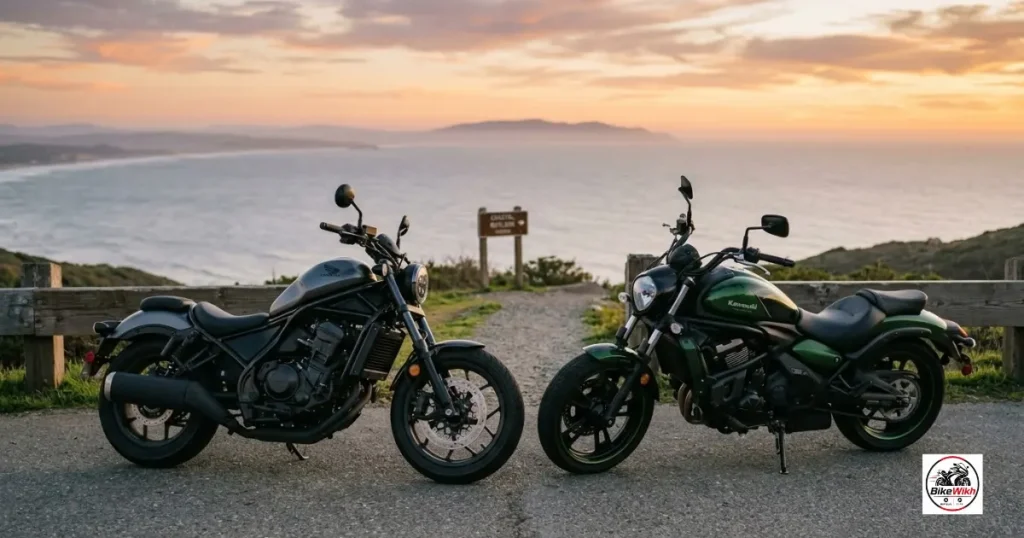
Honda rebel 1100 vs Kawasaki Vulcan s: the sweet spot in the mid-size cruiser market across North America often comes down to how a bike fits your body and your daily riding habits. For decades, entry-level and intermediate cruisers followed a very rigid blueprint: heavy steel frames, lazy V-twin engines, and a complete lack of modern electronic safety nets. While that layout offered plenty of traditional curb appeal, it left a lot to be desired when navigating fast interstate traffic or carving up tight canyon roads. Both Honda and Kawasaki have thrown out the old rulebook, delivering two completely distinct sport-injected cruisers that treat highway performance with absolute seriousness.
The division between these two street machines isn’t just about displacement numbers; it is a fundamental clash of engineering philosophies. One bike borrows its high-torque soul from a rugged global adventure platform, while the other pulls its high-revving DNA straight out of a proven middleweight sportbike chassis.
Honda rebel 1100 vs Kawasaki Vulcan s: Two Entirely Different Approaches to Sport-Cruiser Performance
Swinging a leg over the Kawasaki Vulcan S reveals an immediate connection to the sport-riding world. At the heart of this low-slung custom is a 649cc liquid-cooled parallel-twin engine that sportbike enthusiasts will instantly recognize. Instead of delivering a slow, heavy chug at low RPMs, the Vulcan S loves to rev. As you twist the throttle on an open highway on-ramp, the power builds linearly, rushing eagerly toward the upper limits of the tachometer. It behaves remarkably like a naked sportbike dressed up in a cruiser silhouette, giving you a lively, energetic surge that makes slicing through aggressive morning gridlock a massive amount of fun.
The Honda Rebel 1100 attacks the highway from the complete opposite direction. By packing a much larger 1,084cc liquid-cooled parallel-twin motor into its minimalist frame, the Rebel prioritizes effortless, tire-shredding torque right off the line. You do not need to hunt through the gearbox to find passing power when maintaining a 75 mph pace on the interstate. A simple turn of the wrist provides an immediate, heavy wave of forward acceleration that easily leaves traffic far behind. The engine utilizes a specialized firing interval that perfectly mimics the rumbling syncopation of a classic cruiser, but it delivers that character with modern, vibration-free refinement that keeps your hands and feet completely comfortable over long touring stretches.
The transmission choices split these two roadsters even further. While the Vulcan S relies on a slick, traditional six-speed manual gearbox with a featherweight clutch pull, Honda offers a game-changing option on the Rebel 1100: their advanced Dual-Clutch Transmission (DCT). The automatic DCT completely eliminates the handlebar clutch lever and foot shifter, executing flawless, lightning-fast gear changes on its own. For urban riders stuck in heavy, stop-and-go city lane traffic, or commuters who simply want to focus entirely on the road ahead without managing stall anxieties, this setup represents an incredible luxury that standard cruisers cannot match.
Honda rebel 1100 vs Kawasaki Vulcan s: Ergonomic Customization vs. Raw Electronic Sophistication
When it comes to out-of-the-box comfort, Kawasaki holds a massive card up its sleeve with their adjustable fitment layout. Cruisers are notorious for forcing shorter or taller riders into awkward, uncomfortable reaches to the bars and pegs. Kawasaki solves this by allowing dealerships to swap out the footpads, seats, and handlebars to tailor the bike exactly to your height. This adaptability creates an incredibly natural, custom fit that takes all the strain off your lower back and shoulders. The low center of gravity combined with a slammed seat height ensures you can plant both feet flat on the pavement at a red light, boosting your confidence immediately.
The Rebel 1100 counters this physical adjustment by packing a suite of electronic rider aids that feel incredibly premium for a cruiser under the ten-thousand-dollar mark. Governed by a smart ride-by-wire throttle interface, the Rebel lets you switch between distinct riding modes that alter the traction control boundaries and power delivery maps instantly. If you suddenly hit a heavy summer downpour on a slick asphalt highway, clicking the bike into Rain Mode softens the initial throttle bite, providing a substantial safety cushion that prevents the rear tire from spinning up unexpectedly.
Operating expenses remain incredibly wallet-friendly across both platforms, making them highly practical choices for daily commuting duties. On sustained highway cruising loops, the high-revving Kawasaki consistently returns a highly economical average right around 48 to 52 MPG. The larger Honda Rebel 1100 matches that efficiency beautifully, hovering between 45 and 50 MPG during steady overdrive cruising thanks to its relaxed engine speeds.
Choosing between these two comes down to your personal riding goals. If you want a lightweight, highly customizable cruiser that handles with the sharp agility of a sportbike, the Vulcan S is an absolute masterpiece. But if you crave effortless highway torque, advanced electronic safety suites, and the option for a stress-free automatic transmission, the Honda Rebel 1100 stands completely unchallenged as the king of the modern metric cruiser segment.