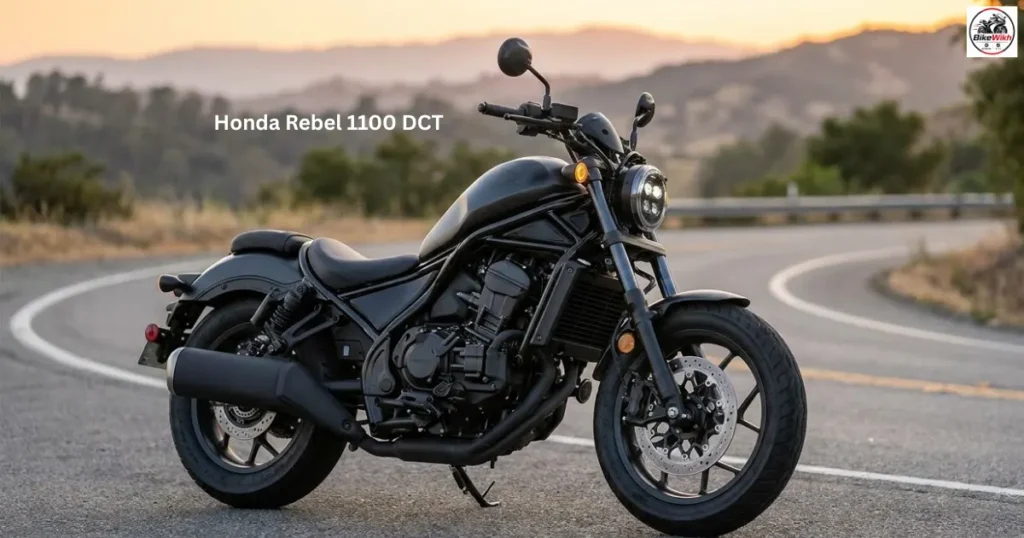
Honda Rebel 1100 DCT : For decades, the American cruiser market was defined by a rigid formula: massive air-cooled V-twins, heavy mechanical cable clutches, and a deep, traditional rumble. While that classic styling remains iconic, a modern wave of open-class metric cruisers is completely rewriting the rulebook. Riders today demand aggressive cornering clearance, advanced electronic safety suites, and everyday commuter practicalities without giving up that low-slung custom look. Honda completely shook up this landscape by introducing its flagship metric weapon: the Honda Rebel 1100 DCT.
Instead of a traditional manual setup, this version of the Rebel features Honda’s revolutionary automatic Dual-Clutch Transmission (DCT). It strips away the clutch lever and shift peg entirely, bringing an incredibly accessible, high-tech twist to a platform powered by a fire-breathing parallel-twin engine.
In this long-term BikeWikh review, we evaluate the real-world highway performance, DCT automatic shifting algorithms, electronic ride modes, true fuel economy (MPG), and daily ergonomics of Honda’s heavy-hitting automatic cruiser.
Honda Rebel 1100 DCT: Technical Performance Specification Matrix
Analyzing the mechanical dimensions of the flagship Rebel shows how Honda blended sport-tuned power into a low-profile bobber chassis.
Engine Type: 1,084cc Liquid-Cooled, Parallel-Twin, Unicam SOHC, 4-Valves Per Cylinder (Africa Twin Derived)
Transmission: 6-Speed Automatic Dual-Clutch Transmission (DCT) with Manual Paddle Shift Modes
Peak Power Output: 86 Horsepower @ 7,000 RPM
Peak Torque: 72 lb-ft (98 Nm) @ 4,750 RPM
Wet Curb Weight: 509 lbs (231 kg) with full fluids
Seat Height: an ultra-low 27.5 Inches (700 mm)
Safety Tech: 6-Axis IMU, Wheelie Control, Selectable Traction Control (HSTC), and Cornering ABS
Engine & DCT Dynamics: Cruising Without a Clutch
The heart of the Rebel 1100 is a retuned version of the 1,084cc parallel-twin engine originally engineered for the legendary Africa Twin adventure motorcycle. Honda heavy-cranked this motor for cruiser duties, packing 20% more flywheel mass to enhance low-end chug and character. The result is a massive, instantaneous hit of 72 lb-ft of torque right off the line, launching the bike forward with surprising sportbike-like urgency.
How the Automatic DCT Alters the Ride
The defining feature of this machine is the 6-speed automatic DCT. It utilizes an independent dual-clutch architecture—one clutch manages odd gears (1st, 3rd, 5th) while the other handles even gears (2nd, 4th, 6th). The system pre-selects the next gear seamlessly before the shift occurs, translating to lightning-fast, seamless gear changes with zero loss of forward acceleration.
For riders dealing with brutal stop-and-go city traffic, the elimination of a heavy clutch lever is an absolute game-changer. If you want total control during spirited canyon carving, you can flick a handlebar toggle into Manual Mode and command instantaneous gear shifts via crisp index-finger and thumb paddle triggers.
Customizable Ride Modes & Canyon Agility
Unlike traditional cruisers that offer zero electronic adjustability, the Rebel 1100 DCT features a sophisticated Ride-by-Wire throttle system packed with four distinct, pre-programmed riding personalities:
- Standard Mode: The optimal baseline setting. It delivers a smooth, linear power curve while keeping the DCT shifts relaxed and efficient for daily commuting.
- Sport Mode: Aggressive throttle response. The DCT holds gears much longer into the high RPM rev range, unleashing maximum acceleration and aggressive engine braking for twisty backroads.
- Rain Mode: Power delivery is heavily softened, and Honda Selectable Torque Control (HSTC) is turned up to max to prevent rear-wheel spin on slick pavement.
- User Mode: Allows you to completely customize your own settings, mixing maximum engine power with early DCT shifts if desired.
When it comes to handling, the Rebel 1100 shatters cruiser stereotypes. Thanks to its rigid tubular steel frame, stiff 43mm cartridge front forks, and pressurized piggyback rear shocks, it loves corners. It offers a surprising 35-degree lean angle, allowing you to slice through mountain curves with confidence without immediately scraping floorboards or exhaust pipes.
Real-World Fuel Economy & Touring Ranges
Thanks to highly advanced electronic fuel injection loops and the DCT’s ability to efficiently short-shift into top gear during highway cruising, operating costs remain impressively low.
- Mixed City & Commuting Fuel Economy: Stop-and-go urban riding and low-gear stoplight blocks yield an average of 38 to 42 MPG.
- Steady Highway Cruising Fuel Economy: Setting the standard cruise control to a steady 65–70 mph pace drops engine RPMs low, returning an outstanding 46 to 50 MPG.
- Riding Range: The low-slung, stylized fuel tank holds 3.6 gallons, giving you a comfortable real-world cruising range of roughly 140 to 165 miles before needing a gas station pitstop.
Honda Rebel 1100 DCT: BikeWikh Cruiser Scorecard
| Cruiser Performance Metric | Honda Rebel 1100 DCT Performance |
| Low-End Torque Punch | (Instant, Africa Twin Derived Power) |
| Urban Gridlock Commuting | (Flawless Automatic DCT Convenience) |
| Canyon Lean Angle | (Impressive 35-Degree Cornering Clearance) |
| Long-Distance Seat Comfort | (Low Stance; Firm Stock Seat Foam) |
The Verdict: A Modern Cruiser Masterpiece
The Honda Rebel 1100 DCT proves that you can enjoy classic custom bobber styling without sacrificing cutting-edge mechanical performance. By blending a monstrous 1,084cc parallel-twin engine with a flawless automatic dual-clutch transmission, comprehensive electronic safety nets, and a incredibly accessible sub-28-inch seat height, Honda has built a cruiser that is equally perfect for daily city commuters and weekend sport-touring enthusiasts alike.